Ultimate Ninjas Children's Book coming to Amazon on Aril 24th!



Mastering the Kinetic Shift: The Science of Open-Loop Agility
Traditional cone drills train predictable movements, but real sports require athletes to react to constantly changing opponents and environments. True agility comes from training the brain and body to quickly read, process, and respond to uncertainty, helping athletes close the gap between seeing a movement and reacting to it.
Why cone drills fail the “real-world” test and how to build a true read-and-react reflex.
In the realm of athletic performance, agility is often misunderstood. Coaches frequently conflate “agility” with “change-of-direction speed”—the ability to sprint through a ladder or weave around cones. While these drills improve footwork, they are what sports scientists call “closed-loop” tasks. The athlete knows exactly what is coming next; the terrain is flat, the target is stationary, and the outcome is predetermined. However, the field of play is an “open-loop” system. It is chaotic, unpredictable, and entirely dependent on environmental variables. True agility is not the ability to follow a pattern; it is the cognitive and physical capacity to resolve uncertainty in real-time.
However, the field of play is an “open-loop” system. It is chaotic, unpredictable, and entirely dependent on environmental variables. True agility is not the ability to follow a pattern; it is the cognitive and physical capacity to resolve uncertainty in real-time.
The Neurology of the “Read-and-React”
True agility requires a seamless integration between the sensory system (visual input), the central nervous system (processing speed), and the motor system (muscular execution). When an opponent changes direction, an athlete has mere milliseconds to:
- Detect the change in orientation.
- Calculate the vector of the opponent’s movement.
- Compute the optimal counter-movement.
- Execute the deceleration and re-acceleration.
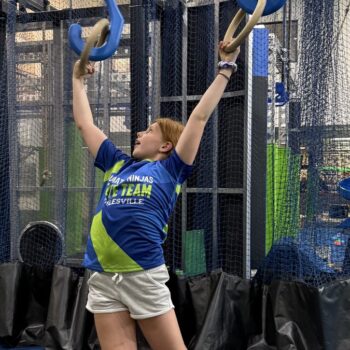
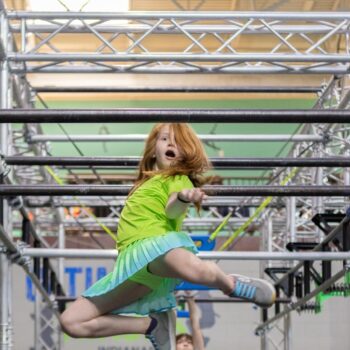
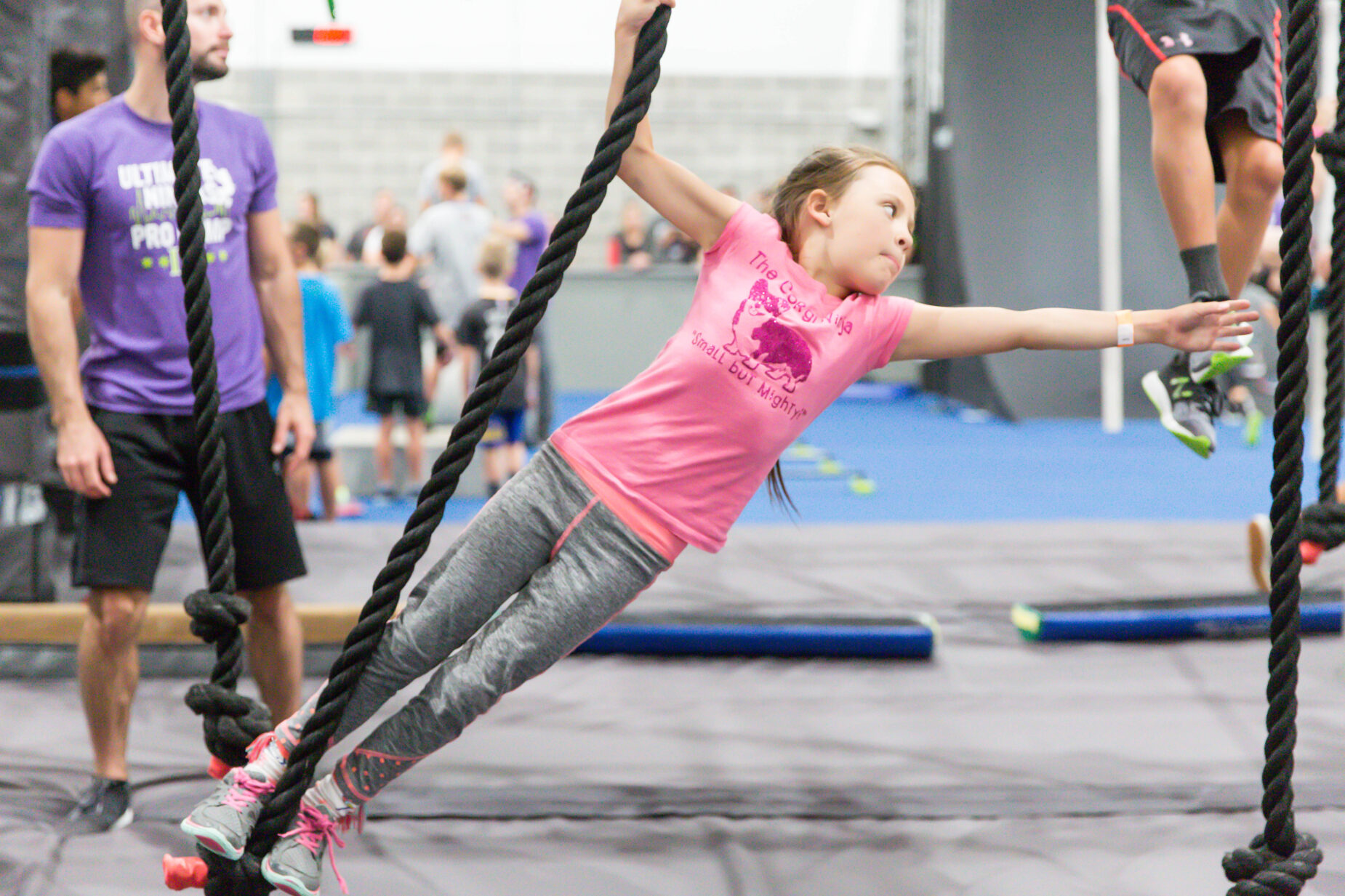
Traditional drills often bypass the first three steps. Ninja training, conversely, forces the athlete to solve these problems constantly. When an athlete traverses a salmon ladder or leaps between rotating steps, the “terrain” is not just moving—it is unpredictable. They cannot pre-program their stride pattern. They are forced to engage in “real-time spatial adaptation.” This trains the brain to optimize the firing of neural pathways, effectively shrinking the “reaction gap”—the time between seeing the move and making it.
The Crossover Connection: Resolving Uncertainty
In high-stakes sports like soccer, basketball, or football, the game is won by the athlete who resolves uncertainty fastest. A defender who anticipates a crossover dribble and executes the shift before the ball-handler has fully committed is an elite performer. This isn’t just “good reflexes”; it is the result of a trained nervous system that is comfortable with chaos. By training in an environment where the ground is a shifting, dynamic variable, we teach the athlete’s body to recalibrate its center of gravity mid-air. This reduces the latency between neural signal and muscular action. When the game slows down for your child, it is because they have developed the capacity to process the “open-loop” chaos of sport, turning erratic plays into calculated movements.
About the Author
These articles are written by the coaching team at Ultimate Ninjas. Our curriculum is developed by experts in youth athletic development, combining principles of biomechanics, sports psychology, and motor learning. With years of experience on the mats, we are committed to providing science-backed, safe, and effective training methods for every child.
Disclaimer: The information provided in these blog posts is for educational and informational purposes only and does not constitute professional medical advice, diagnosis, or treatment. Always seek the advice of your physician or other qualified health provider with any questions you may have regarding a medical condition or physical training.

About the Author
These articles are written by the coaching team at Ultimate Ninjas. Our curriculum is developed by experts in youth athletic development, combining principles of biomechanics, sports psychology, and motor learning. With years of experience on the mats, we are committed to providing science-backed, safe, and effective training methods for every child.