Ultimate Ninjas Children's Book coming to Amazon on Aril 24th!



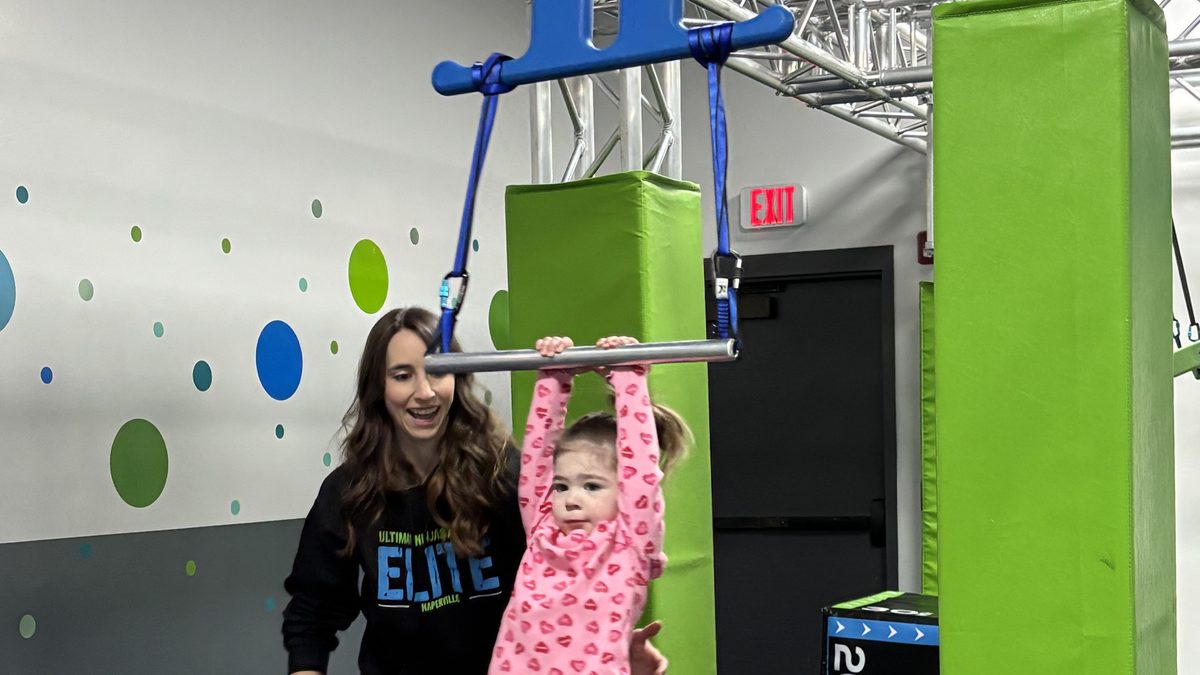
Balance and coordination develop faster between ages three and five than at almost any other point. Here is how classes for this age work, what to expect by age, and what you can practice at home without any equipment.
Table of Contents
Why Balance Develops Early
Balance is not one skill. It is the brain combining information from the inner ear, the eyes, and the pressure sensors in the feet and joints, then adjusting the body faster than conscious thought. That system is still being wired in toddlers.
Coordination sits on top of it. Before a child can catch a ball, they need to stay upright while tracking it, plan the arm movement, and adjust in real time. Every one of those pieces improves with practice on uneven, unpredictable surfaces.
This is why a low beam does more for a three year old than it looks like it should. Wobbling is the work. The corrections a child makes while trying not to fall are the training.
What to Expect by Age
These are general ranges. Kids vary a lot at this age, and being ahead or behind on any single item is not meaningful on its own.
| Age | Typically emerging | What class works on |
|---|---|---|
| 3 years | Standing on one foot briefly, walking a wide line, jumping with two feet | Wide beams, low steps, two foot landings |
| 4 years | Hopping, climbing with alternating feet, catching a large ball | Narrower beams, hanging for a few seconds, simple sequences |
| 5 years | Skipping, balancing longer, combining two movements | Multi step obstacles, short course runs, controlled landings |
If a child is well behind these ranges across several areas, it is worth mentioning to a pediatrician. Coaches see a lot of kids and will often flag something they notice, but they are not evaluating or diagnosing anything.
What a Class Looks Like
Classes for this age run shorter, usually 30 to 45 minutes, because attention span is the limiting factor and not fitness.
Opening circle
Short and predictable. Names, a song or a movement game, and a preview of what the class will do. The routine itself is useful. Kids this age settle faster when the structure repeats.
Station rotation
Three or four stations, a few minutes each. Balance, climbing, hanging, jumping. Rotating keeps attention up and gives every child repeated exposure to each skill without long waits.
Obstacle course
A short course combining the stations. The point is sequencing, which is harder for toddlers than any single element. Remembering what comes next while moving is real cognitive work.
Closing
A calm down activity and a specific bit of praise for each child. Coaches try to name the actual thing the child did rather than saying good job.
Program names differ across locations. You may see these classes listed as preschool ninja classes, mini ninjas, or as part of a broader kids class depending on where you go. Check your location’s page to see what the program is called there and what ages it serves.
The Equipment, Scaled Down
Nothing in a class for this age is a shrunken version of an adult obstacle. The equipment is built for the size and the skill level.
- Beams sit a few inches off the mat and are wider than the ones older kids use.
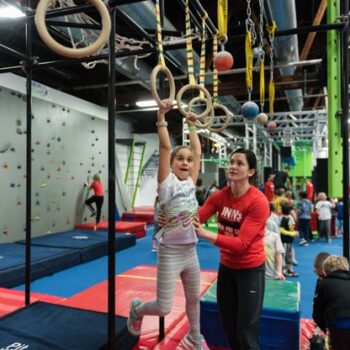
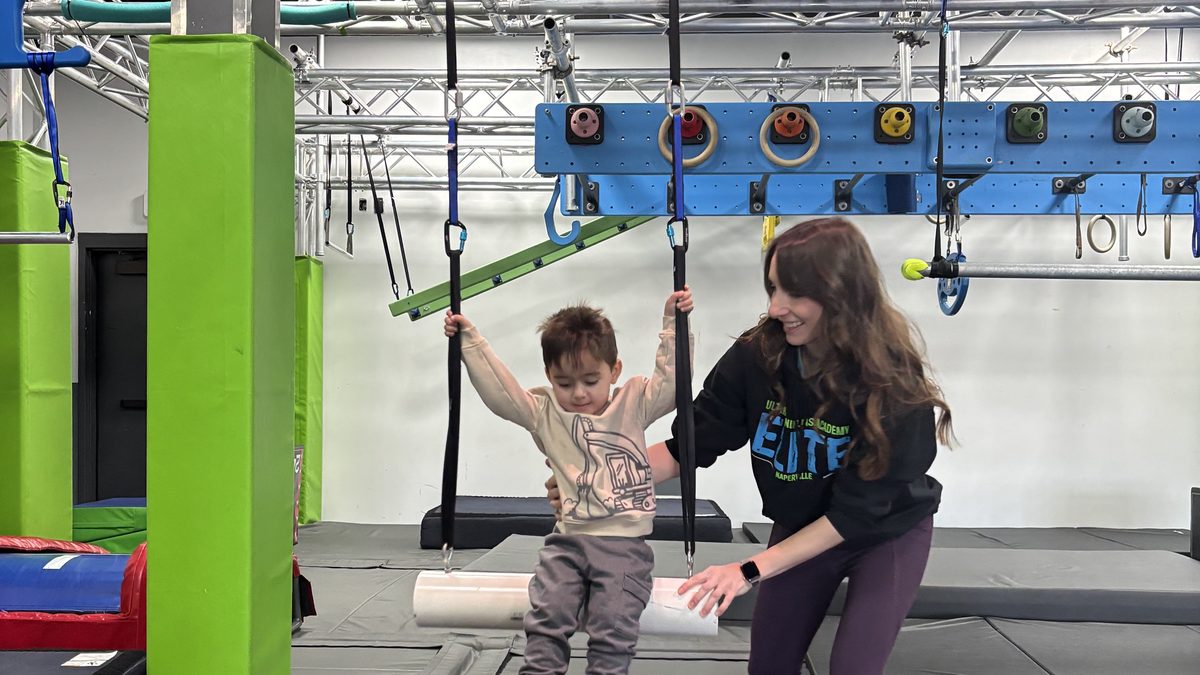
- Hanging bars are set so a child can reach them flat footed or with a small step.
- Climbing walls are short with large, easy to grip holds.
- Landing surfaces are thick mats, and jump heights stay low.
- Soft blocks and foam shapes cover most of the crawling and climbing work.
Coaches stay within arm reach on anything elevated. At this age the coaching is mostly proximity and encouragement rather than technique.
What Parents Can Do at Home
None of this needs equipment.
- Walk along curbs, painted lines, or a strip of tape on the floor.
- Practice standing on one foot while brushing teeth.
- Let them hang from a playground bar for a few seconds at a time.
- Set up a couch cushion path and let them cross without touching the floor.
- Let them climb playground equipment without narrating every risk out loud.
That last one is the hardest and probably the most useful. Kids calibrate their own risk tolerance partly from how the adults around them react.
Frequently Asked Questions
Is three too young?
Three is a normal starting age for a structured class. The main question is whether the child can follow a simple instruction from a coach, not whether they can do any obstacle.
Do I stay with my child?
Some locations run these as parent participation classes and some as drop off. Check your location’s page or call before the first session so you know what to expect.
What if my child cries or will not participate?
Very common in the first class or two. Coaches let a child watch from the edge and join when ready. Forcing participation at this age tends to set things back.
Is it safe for a toddler to hang from a bar?
Yes, at low height over mats with a coach nearby. Hanging is one of the better things a young child can do for grip and shoulder development.
How is this different from open play?
Open play is unstructured and self directed, which has its own value. A class has a plan, a coach, and a progression. Most families end up doing both.
How long before we see a difference?
Coordination changes at this age are gradual and easiest to notice on a playground rather than in the gym. Most parents mention something around the six to eight week mark.
What should my child wear?
Comfortable clothes with no zippers, snaps, or anything that catches. Hair tied back. Footwear requirements vary by location.
Find a Class Near You
If your child is between three and five and you want a structured place to build balance and coordination, come try a class. A first session is usually the fastest way to tell whether the format fits your child. Pick your location below.
About the Author
These articles are written by the coaching team at Ultimate Ninjas. Our curriculum is developed by experts in youth athletic development, combining principles of biomechanics, sports psychology, and motor learning. With years of experience on the mats, we are committed to providing science-backed, safe, and effective training methods for every child.
Disclaimer: The information provided in these blog posts is for educational and informational purposes only and does not constitute professional medical advice, diagnosis, or treatment. Always seek the advice of your physician or other qualified health provider with any questions you may have regarding a medical condition or physical training.

About the Author
These articles are written by the coaching team at Ultimate Ninjas. Our curriculum is developed by experts in youth athletic development, combining principles of biomechanics, sports psychology, and motor learning. With years of experience on the mats, we are committed to providing science-backed, safe, and effective training methods for every child.