Ultimate Ninjas Children's Book coming to Amazon on Aril 24th!



Most sports aren’t won by top running speed—they’re won by how quickly an athlete can react, explode into the first few steps, and change direction under control. Ninja training develops explosive power, balance, coordination, and body control that complement traditional sports training and help young athletes perform with greater confidence
The Secret Weapon Behind the First-Step Acceleration: Why Traditional Running Drills Are Obsolete
In the landscape of youth sports, we are often obsessed with top-end speed—the 40-yard dash, the 100-meter sprint, the “blazing fast” winger. Coaches and parents alike spend thousands of hours on linear speed training, having young athletes run back and forth across a field, convinced that this is the path to athletic dominance.
However, ask any elite collegiate or professional scout what actually separates an average player from a game-breaker, and they will rarely point to straight-line speed. They point to the first step.
They point to the “launch.” It is that instantaneous, biomechanically efficient burst from a dead stop that leaves defenders stagnant, watching from behind. In the realm of elite performance, we call this the Rate of Force Development (RFD). If your child’s training regimen focuses solely on running, they are missing the most critical element of athletic explosiveness. They are training the engine, but they aren’t training the ignition.
The Physiology of the Burst: Fast-Twitch Recruitment
To understand why traditional running drills often fail to produce game-changing speed, we have to look at the physiology of human movement. Athletic power is largely governed by our muscle fiber composition. Specifically, we are talking about Type II, or “fast-twitch,” muscle fibers.
These fibers are responsible for high-force, high-velocity movements—the exact kind needed for a sudden change of direction, a rapid start off the blocks, or a leap for a rebound. Unlike Type I (slow-twitch) fibers, which are designed for endurance and sustained activity, Type II fibers fatigue quickly but generate massive amounts of power.
The problem with standard, linear running drills is that they prioritize the aerobic capacity of Type I fibers. They condition the athlete to endure, but they do little to stimulate the neurological pathways required to recruit those fast-twitch fibers instantly. To unlock true explosiveness, you need a stimulus that forces the body to convert potential energy into kinetic energy in milliseconds. This is where the standard field training model hits a plateau.
The Ninja Difference: Physics as a Training Partner
Enter the Ninja Warrior course. This is not just a playground; it is a laboratory for neuromuscular adaptation. When an athlete faces a Ninja obstacle, they are solving a physics problem with their body.
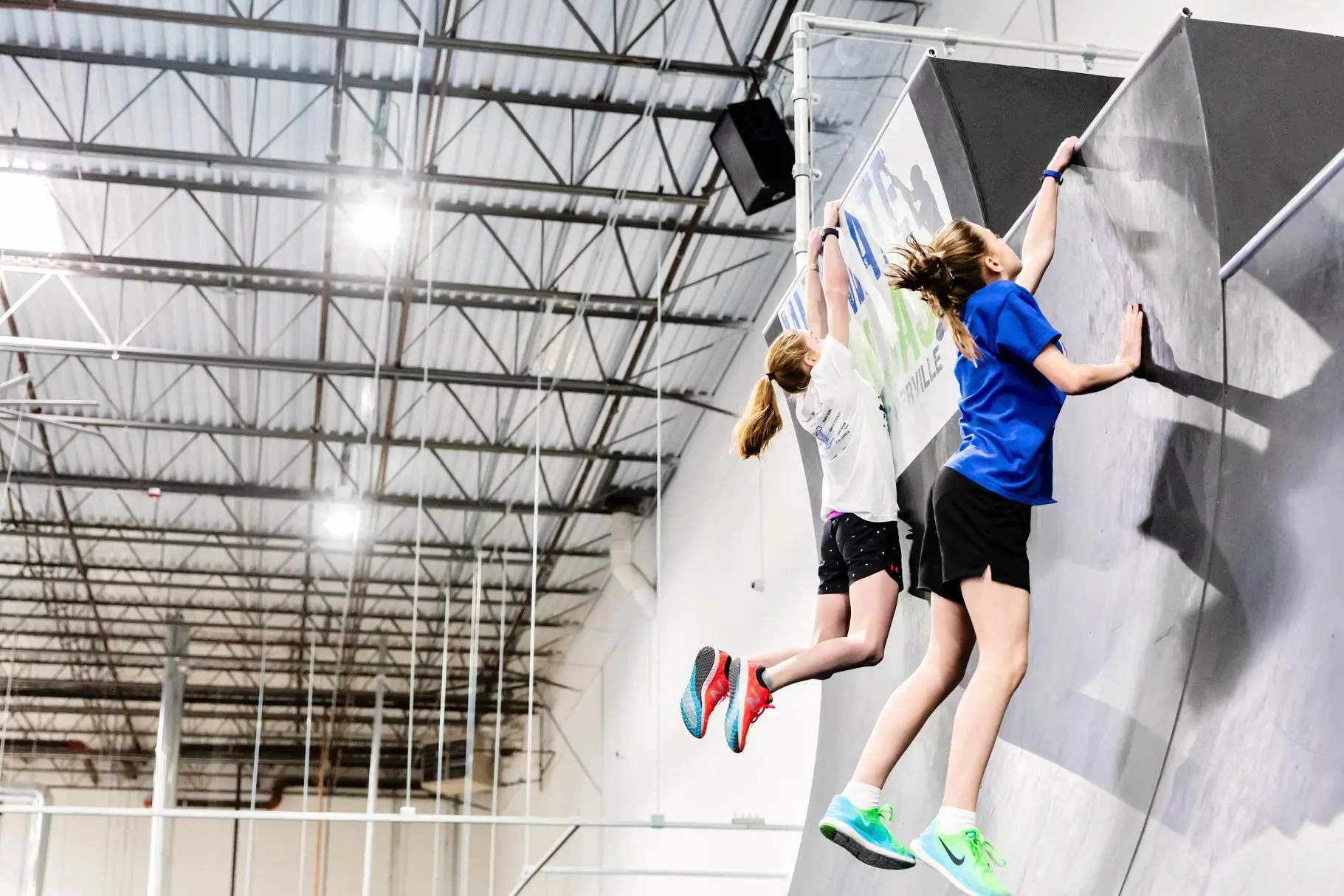
Consider the Warped Wall. You cannot jog up it. You cannot rely on momentum you built thirty yards away. The Warped Wall demands a sudden, seamless conversion of horizontal velocity into pure, vertical climbing power. It requires the athlete to generate maximum ground reaction force in the exact moment of impact.
Or look at the Quintuple Steps. Each contact point is a rapid-fire, plyometric event. The athlete has to hit the step, stabilize the joint, and explode into the next movement without losing a single millisecond of energy to gravity.
In these moments, the body is forced to recruit every available fast-twitch fiber. We aren’t just “training” the muscles; we are training the Central Nervous System (CNS) to fire with more intensity and higher frequency. We are teaching the body to shift into high gear instantly. This is the difference between an athlete who takes time to accelerate and an athlete who is already at full speed by the second step.
The Crossover Connection: Why This Matters on the Field
The beauty of Ninja-based explosive training is that it isn’t “sport-specific”—it is “movement-specific.” And because every sport relies on movement, the crossover is universal.
- On the Diamond: In baseball and softball, the first three steps out of the batter’s box or off the base are the only ones that matter. Ninja training builds the lower-body explosiveness required to explode out of a crouch or a stand, turning a routine grounder into an infield hit, or a near-miss into a stolen base.
- On the Pitch: Soccer is a game of constant, unpredictable starts and stops. A forward doesn’t need to run a marathon; they need to beat a defender to a loose ball by six inches. That six-inch advantage is won in the first step. By training the body to maximize ground reaction force through Ninja obstacles, young soccer players develop the “first-step quickness” that keeps defenders constantly on their heels.
- On the Hardwood: Basketball players are essentially vertical ninjas. The ability to pull up for a jump shot, jab-step past a defender, or explode toward the rim requires a foundation of power that is developed through unilateral (one-legged) strength—exactly the kind of strength developed while traversing a balance beam or navigating a cargo net.
The “Deceleration” Factor: The Hidden Side of Speed
There is a secret about speed that most coaches won’t tell you: you can only go as fast as you can safely stop.
Many young athletes fear moving quickly because they don’t trust their bodies to stop or change direction without falling. This creates a “mental governor” that limits their speed. Ninja training is the antidote. Because our obstacles require constant adjustments, landings, and pivots, we are simultaneously training the body to decelerate.
When an athlete masters the art of the landing—learning how to absorb force through the ankles, knees, and hips—they gain the confidence to push their speed to the absolute limit. They no longer fear the stop, which means they are no longer afraid of the start.
Building the Complete Athlete
We are not looking to replace your child’s soccer practice, baseball training, or basketball skills clinic. We are looking to augment it.
By adding an element of high-intensity, plyometric-focused Ninja training to their regimen, you are providing the neurological and physiological “base” that all sports are built upon. You are ensuring that when the game is on the line, when the clock is ticking down, and when the difference between victory and defeat is a fraction of a second, your child is the one who explodes first.
Don’t just build a runner. Don’t just build an athlete who can move for hours. Build an athlete who understands the art of the launch. Build an athlete who can harness their internal power, tap into their fast-twitch potential, and leave the competition standing still.
About the Author
These articles are written by the coaching team at Ultimate Ninjas. Our curriculum is developed by experts in youth athletic development, combining principles of biomechanics, sports psychology, and motor learning. With years of experience on the mats, we are committed to providing science-backed, safe, and effective training methods for every child.
Disclaimer: The information provided in these blog posts is for educational and informational purposes only and does not constitute professional medical advice, diagnosis, or treatment. Always seek the advice of your physician or other qualified health provider with any questions you may have regarding a medical condition or physical training.

About the Author
These articles are written by the coaching team at Ultimate Ninjas. Our curriculum is developed by experts in youth athletic development, combining principles of biomechanics, sports psychology, and motor learning. With years of experience on the mats, we are committed to providing science-backed, safe, and effective training methods for every child.